

Introduction
In July 2025, Congress passed a budget reconciliation bill (H.R. 1) that cuts $187 billion in federal funding for the Supplemental Nutrition Assistance Program (SNAP) over a 10-year period.[1] Among other cuts, H.R. 1 radically alters funding for SNAP by shifting a percentage of the costs for grocery benefits that are provided to eligible families from the federal government to states that have SNAP error rates of 6 percent or more.[2] SNAP, which is the most efficient and effective anti-hunger program in the country, provides monthly grocery benefits to eligible families with low income.
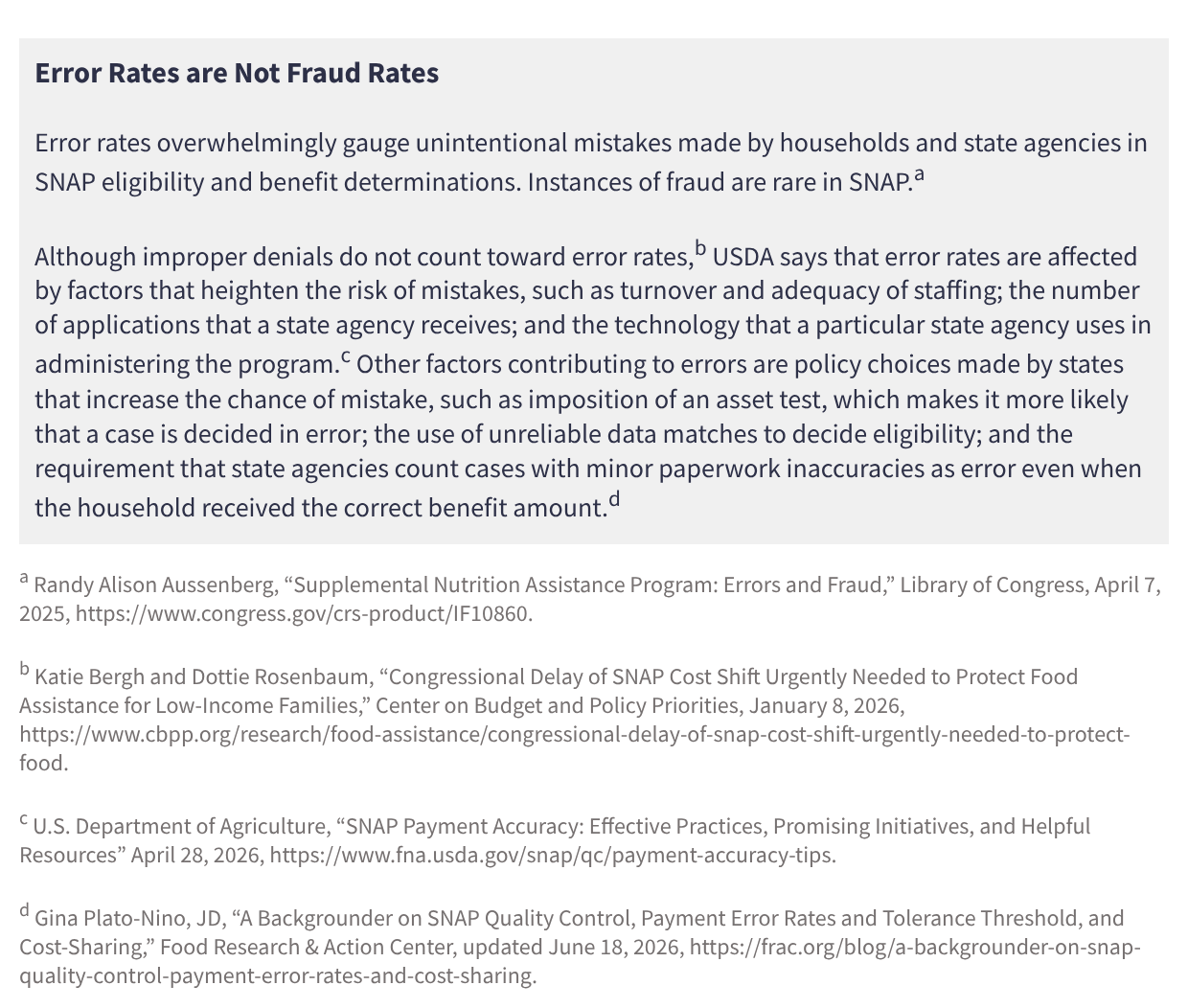
For the first time in the program’s history, states with SNAP error rates of 6 percent or more will be forced to pay from 5 to 15 percent of the cost of grocery benefits that are provided to households depending on how high a particular state’s error rate is. Historically, the federal government has paid for 100 percent of the grocery benefits that are distributed to families in need.
Under H.R. 1, unless Florida significantly lowered its error rate in federal fiscal year (FFY) 2026, which is unlikely since the Department of Children and Families (DCF) has already sampled most of its FFY 2026 cases for errors, the state will be required to pay a percentage of grocery benefits it provides to eligible participants beginning in FFY 2028 — or FFY 2030 if the state qualifies for a temporary delay. The exact amount that Florida will be required to pay, and when, will be based on caseload size and the state’s error rate for either FFY 2025 or FFY 2026. Depending on fluctuations in the size of the state’s SNAP caseload and the exact percentage that Florida may be required to pay, the state could have a cost share for grocery benefits of up to $900 million[3] or more in FFY 2028.[4]
Since FFY 2026 has ended — it began on October 1, 2025, and ended on September 30, 2026 — time is up for Florida to rely solely on making new changes in policies and procedures to reduce SNAP errors. Instead, state lawmakers must act now to replace all federal funds that the state is likely to lose under H.R. 1’s cost share mandate for FFY 2028. SNAP is too important to families who participate in the program and the communities in which they live to risk either reducing access or completely eliminating the program due to inadequate funding.
H.R. 1 Gives Florida Two Options for Determining its FFY 2028 Cost Share for Grocery Benefits
Under H.R. 1, states that have SNAP error rates of 6 to 7.99 percent will be required to pay 5 percent of the cost of benefits provided to eligible households in FFY 2028; states that have error rates of 8 to 9.99 percent will be required to pay 10 percent of the cost of benefits; and states that have error rates of 10 percent or higher will be required to pay 15 percent of the cost of benefits. States with error rates over 13.33 percent in FFY 2026 will qualify for a temporary delay in paying their share of grocery benefits until FFY 2030. As described below, now that USDA has announced FFY 2025 SNAP error rates, Florida has two options remaining for determining the percentage, if any, that the state will have to pay for SNAP grocery benefits in FFY 2028, unless its error rate for FFY 2026 is high enough (i.e., over 13.33 percent) to entitle Florida to delay imposition of the cost share until 2030.
Option 1: Florida Uses Error Rate for FFY 2025
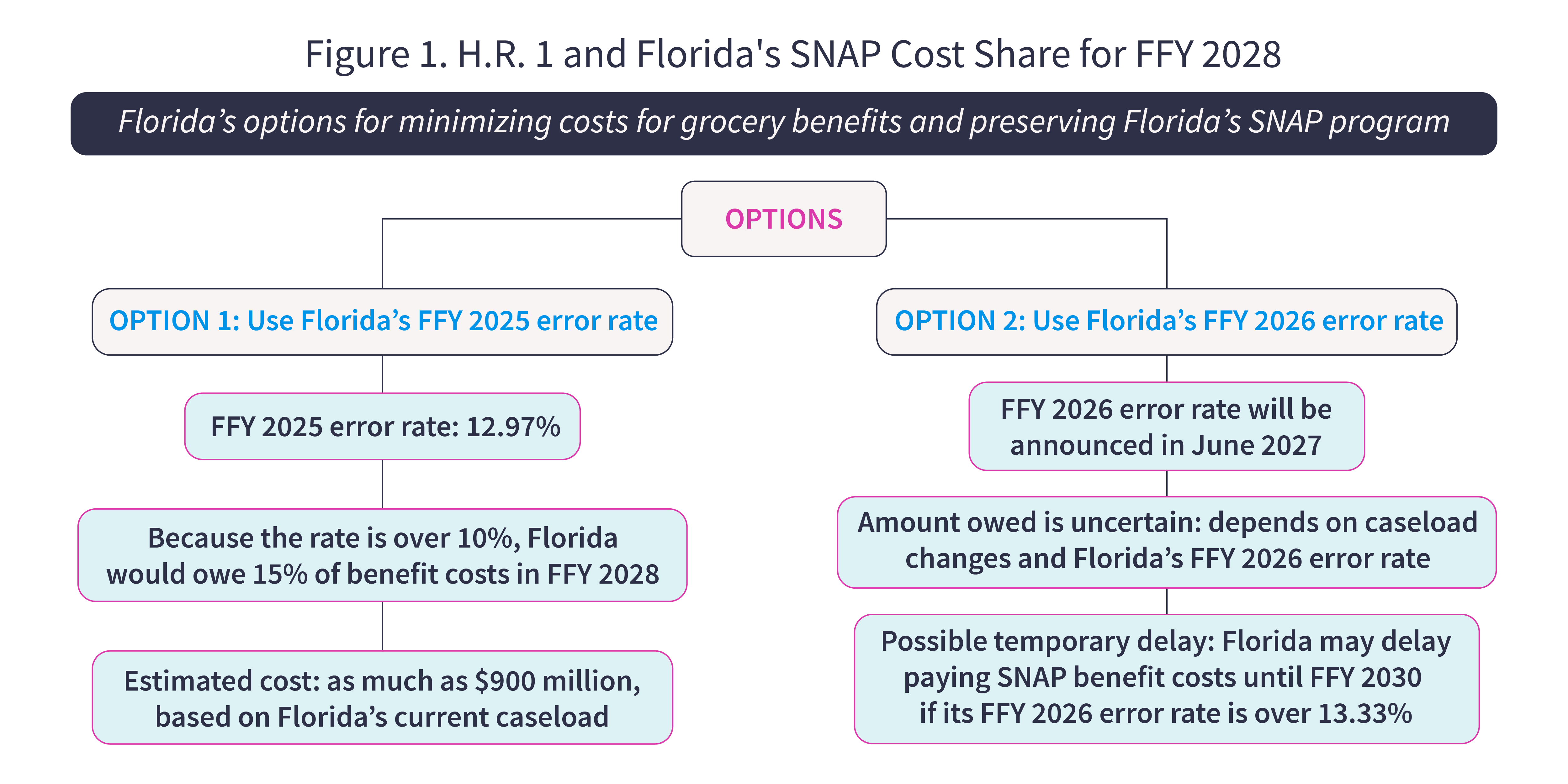
The first option under H.R. 1 allows a state to base its share of the cost for FFY 2028 SNAP benefits on its FFY 2025 error rate. (See Figure 1.) Florida’s SNAP error rate for FFY 2025, which was announced by the U.S. Department of Agriculture (USDA) on June 24, 2026, was 12.97 percent.[5] Although the state’s error rate is down from 15.13 percent in FFY 2024, this reduction is not enough for Florida to avoid its obligation to pay the maximum amount for grocery benefits under H.R. 1. Since the state’s error rate was over 10 percent for 2025, Florida would owe at least 15 percent of the cost of benefits beginning in FFY 2028 under this option — or as much as $900 million based on the size of Florida’s current caseload.[6]
For states, like Florida, whose FFY 2025 error rate puts them on the hook for paying the maximum amount for grocery benefits (i.e., 15 percent) there is a second option.
Option 2: Florida Uses Error Rate for FFY 2026
The second option under H.R. 1 also requires states to begin paying a share of the cost of SNAP grocery benefits in FFY 2028. (See Figure 1.) However, the second option allows states to base the percentage that they must pay on their FFY 2026 error rates, which should be announced in June 2027.
Although this second option has the appearance of giving a state another chance for making headway toward meaningful systemic changes to lower its error rate, it is too late for Florida to create and implement any essential modifications to impact its FFY 2026 error rate. Because the federal fiscal year for 2026 has ended, Florida is out of time [7] to make changes to its staffing, policies, procedures, and technology that would meaningfully affect its error rate for FFY 2026.[8]
Florida May Qualify for Temporary Delay of Cost Share if FFY 2026 Error Rate is 13.33 Percent or Higher
Florida may be entitled under H.R. 1 to temporarily delay paying a share of SNAP grocery benefits until FFY 2030 if its error rate for FFY 2026 is high enough. Under H.R. 1, a specified formula is applied to a state’s FFY 2026 error rate (1.5 × error rate). If the result of this formula is 20 percent or greater, the state will be allowed to delay paying for grocery benefits until FFY 2030.[9] Effectively, the state’s error rate must be 13.33 percent in FFY 2026 to allow the state to qualify for a temporary delay in paying its share of grocery benefits until FFY 2030. During that period of delay, those benefits would remain entirely federally funded.[10]
Until USDA officially announces Florida’s SNAP error rate for FFY 2026, it is impossible to predict whether Florida will be eligible for this temporary delay.
Additionally, H.R. 1 requires that a state’s cost share for future years be determined based on the state’s error rate three years prior. For example, Florida’s share of SNAP grocery benefit costs in FFY 2030 will be based on the state’s error rate for FFY 2027.
Until FFY 2026 Error Rates are Released, Florida’s Fluctuating SNAP Caseload Makes it Impossible to Determine Exactly When and How Much Florida will be Mandated to Pay for SNAP Benefits
USDA announces SNAP error rates every June for the previous fiscal year.[11] On June 24, 2026, USDA revealed FFY 2025 error rates,[12] which covered the period of time[13] from October 1, 2024, through September 30, 2025. The FFY 2026 error rates are expected to be released in June 2027.
To date, the state has not yet made enough progress in reducing errors in administering the SNAP program to eliminate — or even lower — its estimated cost for sharing benefits. If Florida’s error rate for FFY 2026 remains the same as its error rate for FFY 2025 (i.e., 12.97 percent), Florida’s cost share for SNAP benefits for FFY 2028 will be 15 percent of the benefits provided to SNAP participants — or as much as $900 million just to maintain the program.
However, the exact amount that Florida may end up owing for grocery benefits is volatile and depends on fluctuations in Florida’s SNAP caseload. When the economy is strong, the state’s caseload and cost for grocery benefits is likely to fall, as fewer Floridians need help putting food on the table. Conversely, in a recession or disaster, when poverty increases and unemployment rises, Florida’s caseload is likely to grow, which increases the state’s cost for grocery benefits.[14]
Florida Lawmakers Must Act to Fully Fund the SNAP Cost Share
Roughly 2.2 million people participate in SNAP in Florida.[15] Out of these participants, more than half are estimated to be children (37 percent) and seniors (25.6 percent). [16] In addition, hundreds of thousands of people with disabilities as well as 99,000 veterans also receive benefits from Florida’s SNAP program.[17] SNAP has many benefits that impact participating households[18] and the neighborhoods in which they live. The program allows families to afford a nutritionally adequate diet, which — in turn — positively impacts short- and long-term health, academic performance, and overall well-being while decreasing health care costs by an estimated $1,400 per participant every year.[19] Counties and local communities also benefit economically from a strong SNAP program. Every $1 of SNAP spending generates $1.50 in economic activity, which helps shore up local businesses.[20]
The good news is that if Florida shrunk its FFY 2026 error rate, the state may be entitled to reduce or eliminate its cost share for FFY 2028. Additionally, even if the state is required to pay a significant SNAP cost share for initial years, Florida will be buying time to continue working on its error rate so that it can eliminate or reduce its share in future years. This is not an impossibility: in 2018, the state’s SNAP error rate was only 4.39 percent.[21]
The bad news is that Florida is out of time to implement changes designed to make additional headway in slashing its FFY 2026 error rate, which will be used to determine the state’s FFY 2028 cost share. The 2026 Florida Legislature did take steps to address the state’s error rate, such as requiring DCF to submit both monthly reports about its error rate and periodic corrective action plans for reducing errors to state officials,[22] as well as appropriating $4 million for DCF to contract with a vendor to use artificial intelligence (AI) for — among other things — identifying and correcting errors in SNAP eligibly determinations, pinpointing systemic reasons for errors, and suggesting modifications to avoid errors.[23] However, this effort may be too little, too late to affect the state’s error rate and cost share for FFY 2028.
Since time has run out for Florida to invest resources in more staff or focus solely on making SNAP policy, procedural, and technological changes that might have improved its FFY 2026 error rate, the onus is on lawmakers to immediately begin to plan for how Florida will backfill the entirety of federal funds the state is likely to lose under H.R. 1’s cost share mandate. Because cutting other critical services to pay for Florida’s cost share for SNAP would also be harmful to Floridians with low income, the Legislature must identify significant revenue sources to fund SNAP that do not reduce or eliminate other vital programs. If Florida lawmakers do not replace the federal funds lost under H.R. 1, DCF will be forced to reduce critical access to SNAP or do away with the program altogether, which would be devastating to families and communities across the state.
Notes
[1] Randy Alison Aussenberg, “Supplemental Nutrition Assistance Program (SNAP) and Related Nutrition Programs in P.L. 119-21: An Overview,” Library of Congress, Congress.gov, August 15, 2025, https://www.congress.gov/crs-product/R48552.
[2] H.R. 1 - An act to provide for reconciliation pursuant to title II of H. Con. Res. 14, 2025, P.L. 119-21, 139 Stat. 72, https://www.congress.gov/bill/119th-congress/house-bill/1/text.
[3] Katie Bergh and Dottie Rosenbaum, “New Data Underscore SNAP Cost Shift’s Harm to Low-Income Families and State Budgets,” Center on Budget and Policy Priorities, July 23, 2026, https://www.cbpp.org/research/food-assistance/new-data-underscore-snap-cost-shifts-harm-to-low-income-families-and-state.
[4] In fact, the estimate of the cost to Florida for its share of the cost for benefits was recently as high as $984 million for FFY 2028, a projection that was made before H.R. 1’s harsh cuts forced many Floridians off the program.
[5] U.S. Department of Agriculture, “SNAP Payment Error Rates,” June 24, 2025, https://www.fna.usda.gov/snap/qc/per.
[6] Katie Bergh and Dottie Rosenbaum, “New Data Underscore SNAP Cost Shift’s Harm to Low-Income Families and State Budgets,” Center on Budget and Policy Priorities, July 23, 2026, https://www.cbpp.org/research/food-assistance/new-data-underscore-snap-cost-shifts-harm-to-low-income-families-and-state.
[7] This blog was published in October 2026. FY 2026 only runs through September 2026.
[8] Bergh and Rosenbaum, 2026.
[9] H.R. 1 states that, “for fiscal year 2026, the payment error rate of a State multiplied by 1.5 is equal to or above 20 percent, the implementation date…shall be fiscal year 2030.”
[10] U.S. Department of Agriculture, “SNAP Payment Error Rates,” June 24, 2025, https://www.fna.usda.gov/snap/qc/per.
[11] U.S. Department of Agriculture, “SNAP Quality Control: Ensuring Eligible SNAP Households Get the Right Benefits,” June 28, 2026, https://www.fna.usda.gov/snap/qc.
[12] Katie Bergh and Dottie Rosenbaum, “New Data Underscore SNAP Cost Shift’s Harm to Low-Income Families and State Budgets,” Center on Budget and Policy Priorities, July 23, 2026, https://www.cbpp.org/research/food-assistance/new-data-underscore-snap-cost-shifts-harm-to-low-income-families-and-state.
[13] Bill Heniff, Jr., “Basic Federal Budgeting Terminology,” Library of Congress, Congress.gov, November 26, 2012, https://www.congress.gov/crs-product/98-410.
[14] Robert Greenstein, Brynne Keith-Jennings and Dottie Rosenbaum, “Factors Affecting SNAP Caseloads,” Center on Budget and Policy Priorities, August 8, 2018, https://www.cbpp.org/research/factors-affecting-snap-caseloads.
[15] Florida Department of Children and Families, “Standard Data Reports: Caseload: August 2026,” https://www.myflfamilies.com/services/public-assistance/additional-resources-and-services/ess-standard.
[16] Food and Nutrition Service, U.S. Department of Agriculture, “Characteristics of Supplemental Nutrition Assistance Program Households: Fiscal Year 2024,” April 2026, https://fna-bwbufwdzbabpezgc.z01.azurefd.us/sites/default/files/resource-files/snap-fy2024householdcharacteristics-report.pdf.
[17] Luis Nuñez, “SNAP Helps 1.2 Million Veterans with Low Incomes, Including Thousands in Every State,” Center on Budget and Policy Priorities, April 2, 2025, https://www.cbpp.org/research/food-assistance/snap-helps-12-million-veterans-with-low-incomes-including-thousands-in.
[18] Cindy Huddleston and Norin Dollard, “SNAP Matters,” Florida Policy Institute, https://cdn.prod.website-files.com/5cd5801dfdf7e5927800fb7f/627bdd37654866352ece97f7_SNAPOnePager%20(1).pdf.
[19] Todd Datz, “SNAP funding cuts threaten food security, health,” Harvard University School of Public Health, August 21, 2025, https://hsph.harvard.edu/news/snap-funding-cuts-threaten-food-security-health/.
[20] Dottie Rosenbaum, Stacy Dean and Zoë Neuberger, “The Case for Boosting SNAP Benefits in Next Major Economic Response Package,” Center on Budget and Policy Priorities, May 22, 2020, https://www.cbpp.org/research/food-assistance/the-case-for-boosting-snap-benefits-in-next-major-economic-response.
[21] U.S. Department of Agriculture, “SNAP Payment Error Rates: FY 2018,” June 24, 2025, https://www.fna.usda.gov/snap/qc/per.
[22] General Appropriations Act, Ch. 2026-232, Laws of Florida, Line Item 313, https://laws.flrules.org/2026/232.
[23] General Appropriations Act, Ch. 2026-232, Laws of Florida, Line Item 313, https://laws.flrules.org/2026/232.