

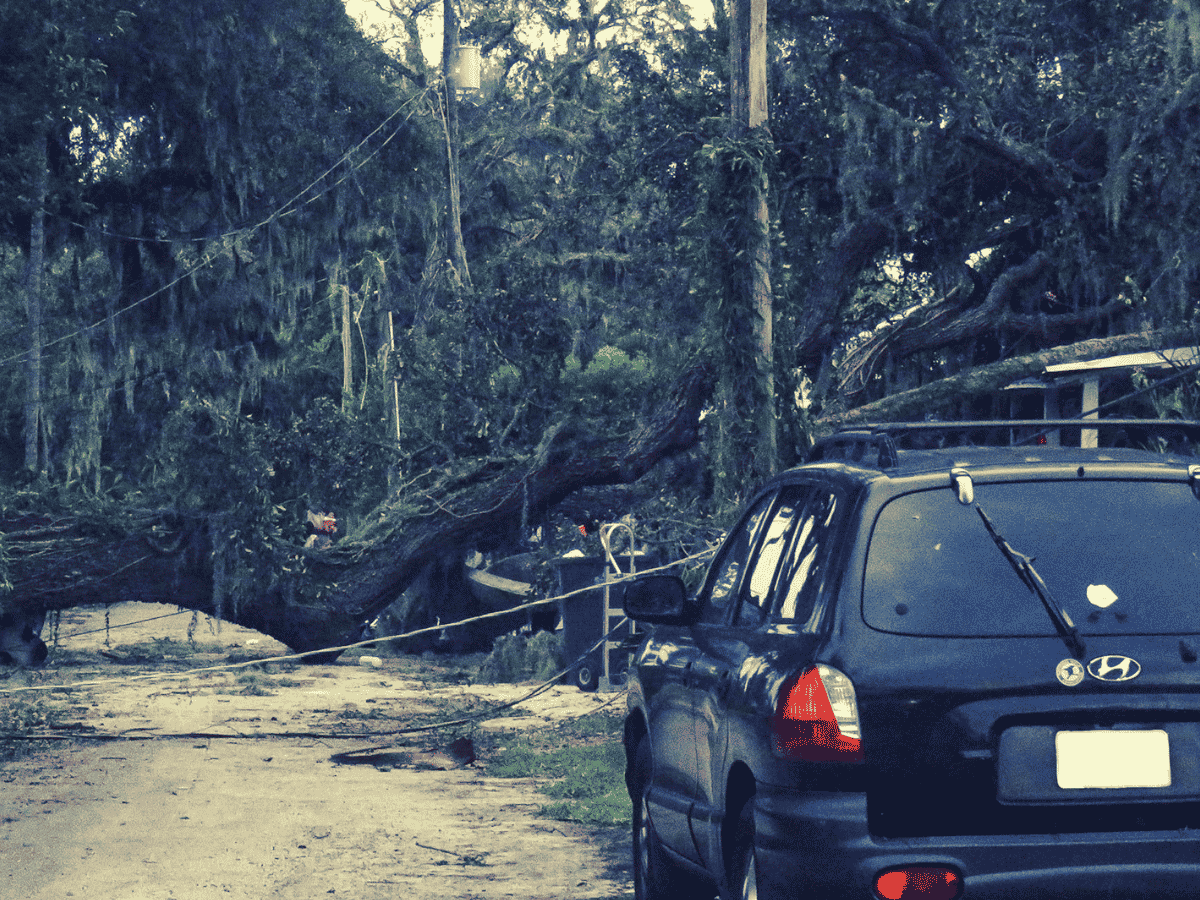
Federal aid plays a crucial role in helping Sunshine State families and communities recover from hurricanes, tropical storms, and flooding. A recent Florida Policy Institute (FPI) analysis shows that such disasters caused $38.85 billion in documented damages in 2023-2024 alone, with federal assistance programs covering $16.18 billion in recovery costs so far.
In November 2026, Floridians will vote on Amendment 3, which would cut the property tax revenue that counties, cities, and special districts rely on for essential services, from hospitals to libraries to disaster response. Property taxes fund the local half of disaster response — the crews that clean up storm debris and restore power, the Floridians who operate emergency hotlines and shelters, and the reserves that front costs while waiting on Federal Emergency Management Agency (FEMA) Public Assistance reimbursement. Once a disaster receives a federal disaster declaration, FEMA must cover 75 percent of the state and local response and recovery costs. For disasters that do not receive a federal disaster declaration, jurisdictions fund the response and recovery costs on their own.
However, the federal administration is exploring ways to shift more disaster costs from the federal government down to states and localities — as proposed by the administration's FEMA review council — at the same time that Amendment 3, if passed, would shrink the revenue base needed to absorb increased expenditures. If that happens, Florida governments (and by extension, households) would take both hits at once, with the storm bill and the revenue loss compounding.
Property taxes fund the local half of disaster response — the crews that clean up storm debris and restore power, the Floridians who operate emergency hotlines and shelters, and the reserves that front costs while waiting on Federal Emergency Management Agency (FEMA) Public Assistance reimbursement.
The FEMA Review Council’s charge was focused from the outset on finding ways to cut the federal government’s role in disaster recovery.[1] Yet, the administration did not wait for the council's report to begin shrinking the agency. The administration effectively froze Hazard Mitigation Grant Program funding for new disasters beginning in March 2025. In April 2025, FEMA abruptly canceled the Building Resilient Infrastructure and Communities (BRIC) program, rescinding nearly $300 million in planned mitigation projects across Florida before a federal court ruled the termination unlawful and FEMA reinstated the program. These mitigation projects included funding to improve drainage, decrease neighborhood flood risk, and an upgraded facility for first responders in Key West.
In May 2026, the FEMA Review Council released its recommendations, which called for moving a substantially larger share of recovery costs onto states, local governments, and households — with outsized stakes for Florida. The Urban Institute estimates these proposals, applied to 2008–2024 disasters, would have shifted roughly $41 billion in costs to states, with Florida being among the states that would have lost the most.
Out of all of the public comments the review council received, 99 percent were supportive of FEMA and urged the administration not to diminish the agency or cut funding.
Below, FPI summarizes how the council’s recommendations could impact families and communities in Florida, including how this would intersect with the potential for property tax cuts under Amendment 3.
Floridians Could Shoulder More Disaster-Recovery Costs Just as Amendment 3 Shrinks County Budgets
While FEMA, by statute, covers at least 75 percent of state and local recovery costs for federally declared disasters, it often reimburses well above 75 percent, including for Hurricane Ian, the most costly storm in Florida’s history. FEMA reimbursed Lee County, the state government, and other impacted jurisdictions 100 percent of Hurricane Ian storm response costs.
When a big storm hits a county with fewer resources (i.e., fiscally constrained), as Michael did with Bay County in 2018, the recovery costs can overwhelm the fiscal capacity of local jurisdictions.
The FEMA Review Council has recommended reducing FEMA’s reimbursement share from 75 to 50 percent. In practice, the cut would be far deeper: FEMA reimbursed Florida at 100 percent for hurricanes Michael, Ian, Helene, and Milton, and at 90 percent for Irma. So, the change would amount to a 40-50 percent reduction, shifting billions in recovery costs onto state and local governments.
FPI examined the Public Assistance reimbursement figures for five of the largest recent hurricanes (Milton, Helene, Ian, Michael, and Irma), focusing on the counties where the storms made landfall and accounting for the projected revenue-loss impact under Amendment 3. (See Table 1.) For every storm, FEMA’s actual reimbursement ran well above the 75 percent minimum. When a big storm hits a county with fewer resources (i.e., fiscally constrained), as Michael did with Bay County in 2018, the recovery costs can overwhelm the fiscal capacity of local jurisdictions.[1]
The state's potential exposure to billions in new disaster costs deserves its own accounting. Under Florida Statute 252.37(5)(a), the state pays the full match on its agencies' disaster work — National Guard deployments, debris removal missions, emergency sheltering operations, and repairs to state buildings, parks, and infrastructure — plus half of every local government's match. At the council's 50 percent floor, that adds up quickly. (See Table 2.)
It is important to note that these figures understate the real extent of the exposure. FPI only analyzed FEMA Public Assistance reimbursement figures for five of the most recent significant (Category 3 and above) storms. The analysis does not include potential impacts of the review council's proposed cuts to Individual Assistance, mitigation funding, or the higher declaration thresholds that would deny federal help for smaller disasters entirely. Plus, they only reflect obligations to date for Ian, Helene, and Milton — while FEMA's own projections show billions more in costs still to come.
The Number of Florida Households Without Flood Insurance Could Rise
The FEMA Review Council also recommended shifting existing National Flood Insurance Program (NFIP) policies to the private market through a “take-out” program modeled on state depopulation programs, such as Citizens Property Insurance Corporation’s Depopulation Program. Existing NFIP policyholders would be required to take a private market plan that offers a rate that is no more than 10 percent higher than their existing plan. Many stakeholders argue that this amounts to privatization and would therefore push households toward higher premiums or no coverage. The National Association of Homebuilders, jointly with the National Association of Realtors, urged the council to reject this plan, arguing that it is “not prudent or realistic to expect the private sector to absorb the estimated 35 to 45 million high-risk properties identified by the American Property and Casualty Association.” Separately, a broad-based coalition of mortgage bankers, insurance agents, and floodplain managers has pressed Congress for long-term NFIP reauthorization.
The FEMA Review Council report offers no mechanism to expand the number of households with flood coverage, and its gestures toward affordability only amount to a mere suggestion that Congress address the question later on.
Florida is at an especially high flood risk compared to other states. Floridians hold one-third of all NFIP policies, while representing just 7 percent of the US population. Between 2020 and 2025, the NFIP paid out $13.9 billion to 152,702 Florida claimants to compensate for flood damage losses.
When both Hurricane Helene and Hurricane Milton flooded Tampa Bay in the fall of 2024, roughly 85 percent of flooded households had no flood insurance, according to disaster recovery plans filed by Pinellas County and the City of St. Petersburg. In Pinellas County alone, 164,594 households without coverage reported flood damage to FEMA, nearly seven times the 25,430 households that did have coverage. Those uninsured losses landed on households already burdened by rising insurance premiums and the rising cost of living — by the end of 2025, Tampa led the nation in home foreclosures. However, Tampa Bay is not an outlier; statewide, at least 59 percent of single-family homes in FEMA flood-risk zones lack NFIP coverage.
The FEMA Review Council report offers no mechanism to expand the number of households with flood coverage, and its gestures toward affordability only amount to a mere suggestion that Congress address the question later on.
Floridians Could See Fewer Individual Assistance Dollars
Another one of the review council’s recommendations would effectively reduce the amount of aid available through FEMA Individual Assistance — a critical lifeline for low- and moderate-income families. Individual Assistance provides direct grants to cover temporary housing, home repairs, and essential needs for disaster survivors who otherwise lack the insurance or savings to recover from disasters on their own.
The proposed single payment reserved for destroyed homes, where the value of the one-time payment is determined based on the home’s value and severity of disaster damage, would thereby leave many Florida families with nothing.
The council proposes collapsing FEMA's roughly 15 categories of Individual Assistance into a single, one-time payment: up to $150,000 for homeowners whose homes are left uninhabitable, and up to six months of rent for displaced renters, per the council's final report. While these numbers may sound generous, this consolidation would cut out many survivors who currently qualify for the Individual Assistance Program. For example, Floridians whose homes remain livable, yet who have lost vehicles or personal property, or those who face funeral or medical costs after a storm, would no longer qualify through FEMA's Other Needs Assistance program, as it would be eliminated.
Individual Assistance dollars have been a lifeline for Floridians. FEMA provided more than $1.7 billion directly to survivors for uninsured (and underinsured) losses after Hurricane Helene (2024) and Hurricane Milton (2024), more than $1 billion to Floridians after Hurricane Irma (2017), and over $1.1 billion after Hurricane Ian (2022). Most of that help had arrived as modest grants that bridged the gap between disaster and the first insurance check (insurers have 60 days to approve or deny a claim under Florida Statute 627.70131(7)(a)). The proposed single payment reserved for destroyed homes, where the value of the one-time payment is determined based on the home’s value and severity of disaster damage, would thereby leave many Florida families with nothing.
Notes
[1] During a January 2025 visit to hurricane-damaged North Carolina, President Trump said he was considering getting rid of FEMA and that he would "rather see the states take care of their own problems." Shortly thereafter, he established the FEMA Review Council by Executive Order. Two months later, former Homeland Security Secretary Kristi Noem told a Cabinet meeting, "We're going to eliminate FEMA."