

Florida Policy Summit 2026
Florida Policy Summit 2026
Florida’s out of excuses to expand KidCare
It’s time to implement the bipartisan law passed nearly three years ago.

SNAC Newsletter: March 2026
SNAC Newsletter: March 2026
Statement on Florida's 2026 Legislative Session
Florida lawmakers did not address key cost-of-living issues during the 2026 regular session, like skyrocketing health care and energy costs.
Florida Withdraws ‘Continuous Coverage’ Lawsuit — Will the State Finally Implement KidCare Expansion for Florida Children?
In February 2026, Florida dismissed its remaining lawsuit against CMS and HHS over the continuous coverage requirement.
Thousands of Vulnerable Immigrant Seniors and Children Living Lawfully in the U.S. Are Going Hungry Under H.R. 1
One of the cuts made to SNAP by H.R. 1 is to significantly limit the categories of legal immigrants who can qualify for benefits to people who are: lawful permanent residents (LPR and green card holders), Cuban and Haitian Entrants, or Compacts of Free Association Citizens. As Florida grapples with the implementation of these changes, it is clear that this new law jeopardizes the food security and health of some of the most vulnerable people in Florida, including immigrants who are either seniors or children, as well as the economic health of the communities in which they live.

Someone will have to pay for Florida’s irresponsible plan to cut property taxes
Property taxes support a wide range of public services and programs.
Florida Budget Proposals: Paving a Path Toward Austerity
Within the context of looming deficits, leaders in the Florida House and Senate clearly believe they are dealing with a spending problem with a simple solution: fewer expenditures. However, there are at least three issues that complicate this approach that policymakers ought to consider as they negotiate and finalize the budget: H.R. 1, the state’s tax preferences, and persistent funding gaps.

SNAC Newsletter: February 2026
SNAC Newsletter February 2026
SB 1052 and HB 1279’s Bans Are Harsh, Limiting Higher Education Enrollment and Financial Support for Immigrants
In the 2026 session, the Legislature has introduced two broad education bills — HB 1279 and SB 1052 — with numerous provisions, including removing Title IX gender diversity requirements and limiting higher-education enrollment for immigrants. This blog focuses on the latter, concerning anti-immigrant provisions.
Statement on Florida House Amending HB 693, Preserving Health Care for Immigrant Children
"We are pleased that the Florida House has removed language in HB 693 that would have banned certain lawfully residing immigrant children from the Children’s Health Insurance Program (CHIP) and Medicaid.

Statement on Florida House Passage of HJR 203
HJR 203 represents nothing more than a cost shift.
Schools of Hope Rule Would Continue Shortchanging Florida's Public Schools
The proposed rule represents only incremental change.
Medicaid Work-Reporting Requirements in Florida Still Do Not Make Sense
This legislative session, Florida representatives have proposed SB 1758/HB 1453, which impose work-reporting requirements (WWRs) for adults aged 19–64 (SB 1758) or 18–64 (HB 1453), who don’t meet certain exemptions.
Testimony on HB 1279 Provided to the Florida House Budget Committee
FPI opposes the bill for its provisions seeking to keep bright immigrants from pursuing higher education in the state.
Bill Summary: HJR 201, 203, 205, 207, 209, 211, and 213
The measures would cost localities anywhere from $6.7 billion (HJR 205) to $18.3 billion (HJR 201) annually.
Bill Summary: SB 318
SB 318 would bring much greater transparency and accountability to the state’s universal voucher program.
Bill Summary: SB 1758/HB 1453
In July 2025, the U.S. Congress passed H.R. 1, titled the “One Big Beautiful Bill Act,” which included significant cuts to Medicaid financing as well as changes to Medicaid and Supplemental Nutrition Assistance (SNAP) eligibility for certain immigrant populations.
Bill Summary: HB 693
In July 2025, the U.S Congress passed H.R. 1 — titled the “One Big Beautiful Bill Act” — which included significant cuts to Medicaid financing, as well as changes to Medicaid and Supplemental Nutrition Assistance (SNAP) eligibility for certain immigrant populations.
Bill Would Block Access to Medicaid and CHIP for Certain Immigrant Youth
The bill, HB 693, would go a step further than the harmful policy changes already implemented under H.R. 1.
Florida Voters by Nearly 2 to 1 Margin Favor Property Insurance Relief Over Property Tax Relief
Almost half of Florida voters oppose eliminating property taxes on homesteads.
2026 Policy Agenda
Florida Policy Institute (FPI) supports measures that help make the state a place where families can build a healthy future and where workers and businesses can thrive — a state where historical barriers to economic mobility have been removed so that everyone can share in widespread prosperity.
Statement on US House Approval of Legislation That Would Extend Enhanced Premium Tax Credits
The last thing Floridians can afford right now is a dramatic increase in health care premiums.
Schools of Hope Threaten Florida’s Neighborhood Schools
According to the Florida Department of Education (FLDOE), charter schools “are public schools that operate under a performance contract, or a ’charter’ which frees them from many regulations created for traditional public schools while holding them accountable for academic and financial results.”
Impact Report 2025
FPI's annual report on its research and policy work over the course of 2025.
Statement on Florida House Property Tax Committee Advancing Proposals to Cut or Eliminate Property Taxes
Tax relief should be targeted to people who need it most.
FY 2025-26 Budget Summary: Corrections and Youth Justice
Florida’s Department of Corrections (DOC) faces several challenges— ranging from budget cuts, understaffing, an aging population that requires intensive and specialized medical care, and aging infrastructure. Secretary Ricky Dixon, explained how the department’s chronic understaffing issue poses a threat to the safety of the incarcerated and staff. Furthermore, Secretary Dixon detailed how the lack of staff has contributed to more overtime pay, which has caused the department to operate at a $189 million deficit.

At Least 690 ‘Letters of Intent’ Sent to Public Schools in Florida
The letters were sent as of November 11, 2025.
How Florida is Spending its Disaster Recovery Dollars — and What it Reveals About Our Priorities
More than $4 billion in federal disaster recovery funding is now flowing to Florida communities to help them recover from 2023–2024 storms, reshaping local budgets and recovery efforts from Fort Myers, to Cedar Key, to Tallahassee.
Statement on SNAP and Federal Court Rulings
The start of November is proving to be one of profound hardship for millions of Floridians.
Challenges Ahead: What Census Data Reveals about the Wealth Gap and Uninsured Rate as Florida Braces for H.R. 1
Millions risk losing access to basic needs services, assistance, and health insurance.
Florida's Supplemental Nutrition Assistance Program (SNAP) is at a Crossroads
The federal government has always paid 100 percent of the grocery benefits provided to families participating in the Supplemental Nutrition Assistance program (SNAP). However, due to H.R.1—the reconciliation bill recently enacted by Congress—these benefits are no longer fully guaranteed.
When the Next Storm Hits, Will Florida Be Left on Its Own?
Florida faces $14.8 billion in documented unmet recovery needs, even with historic federal funding.
Florida by the Numbers: Minimum and Living Wage Dashboard
Far too many Floridians struggle to make ends meet at a $14 wage.
Florida FY 2025-26 Budget Summary
Read FPI's budget summaries for FY 2025-26, by issue area.
Medicaid Calculator: Could You Be Eligible For Health Insurance?
Florida Medicaid Calculator
High Heat, Higher Responsibility (2025): The Sunshine State Must Enact Policies to Protect Working Floridians
An estimated 611,100 Floridians work outdoor jobs.
Roughly $18.5 Billion at Stake for Florida Counties, School Districts, and Municipalities if Property Taxes on Homesteads are Eliminated, Think Tank Finds
FPI previously cautioned that eliminating property taxes would tie local lawmakers’ hands.
Homestead Property Tax Revenue is Crucial to Florida Counties, School Districts, and Municipalities (Map)
Eliminating property taxes is a costly decision.
Florida FY 2025–26 Budget Summary: Health
On July 4, 2025, Congress passed the federal reconciliation bill (H.R. 1) which guts nearly $1 trillion from health care spending, including $800 billion expected to come from the Medicaid program, while the other cuts come from the Affordable Care Act (ACA) Marketplace.
Register Now! Three-Part Webinar Series on Florida’s Fiscal Year 2025-26 Budget and Policy Landscape
FPI is hosting three virtual discussions to dive into the current policy landscape and FY 2025–26 budget analysis.
Health and Back to School: Florida’s Inadequate Implementation of Child Health Policy
The state's lack of accountability has contributed to a system of inadequate care in Florida, especially for children.
Bill Summary: H.R. 1 (SNAP Provisions)
H.R.1 will shift as much as $1.2 billion each year in SNAP costs from the federal government to Florida.
"Alligator Alcatraz” Cost Law, Lives, and Urgent State Priorities
In just eight days in June 2025, a South Florida Detention Facility was built on a remote airfield deep in the Florida Everglades, spanning Miami-Dade and Collier counties. The detention facility, managed by the Florida Division of Emergency Management, was designed to detain up to 3,000 people with an estimated $450 million annual operating cost.
Florida Budget Summary FY 2025–26: Natural Resources, Environment, Growth Management, and Transportation (NREGMT)
In a natural disaster-prone state like Florida, investment in environmental conservation efforts and updated state infrastructure is of utmost importance. Such investments are particularly important in South Florida, where climate equity and gentrification are growing issues of concern.

Florida FY 2025–26 Budget Summary: Education
This year, Florida’s education landscape was partly obfuscated by the uncertainty around federal education policy. The release of the Heritage Foundation’s Project 2025 in the fall of 2024—which was viewed as the blueprint for federal-level policy changes—provided insights on likely changes to federal policies, including the role and scope of the Department of Education.

Raising the Alarm on the Oncoming Tidal Wave of Health Care Coverage Loss for Florida
As a state that has not expanded its Medicaid program, Florida will be particularly hard hit by this coverage loss.
How Historic Cuts to SNAP Enacted by Congress Jeopardize the Food Security of Floridians in Need and the State’s Entire Program
H.R. 1—the federal reconciliation bill that became law on July 4, 2025—spells disaster for Florida by cutting $186 billion in federal funding from the Supplemental Nutrition Assistance Program (SNAP), as well as imposing new restrictions on eligibility requirements that unnecessarily limit access to nutrition assistance to people who are the most in need.
Florida’s $4 Billion in Disaster Recovery Funds Must Include Homeowner Reimbursements
In January 2025, the U.S. Department of Housing and Urban Development (HUD) awarded $4 billion in Community Development Block Grant Disaster Recovery (CDBG-DR) funding to Florida to help meet unmet recovery needs from 2023 and 2024 storms. Yet despite the scale of the recovery crisis and the availability of federal funds — with damages from both Helene and Milton alone exceeding $100 billion — the Florida Department of Commerce has refused to establish a Homeowner Reimbursement Program.
Florida FY 2025-26 Budget Summary: General Government (Affordable Housing, Basic Needs Programs, and Economic Development)
Florida continues to fall behind other states in promoting economic security and self-sufficiency for residents struggling to make ends meet. Currently, over 3 million Floridians face hunger, including one in five children. Unfortunately, the ongoing erosion of the state’s basic needs programs leaves families who are experiencing hard times with few—if any—resources to meet their needs. To make matters worse, H.R. 1 (P.L. 119-21, also known as the One Big Beautiful Bill Act), the federal reconciliation bill that Congress recently passed, will deepen Floridians’ inability to meet their everyday needs.
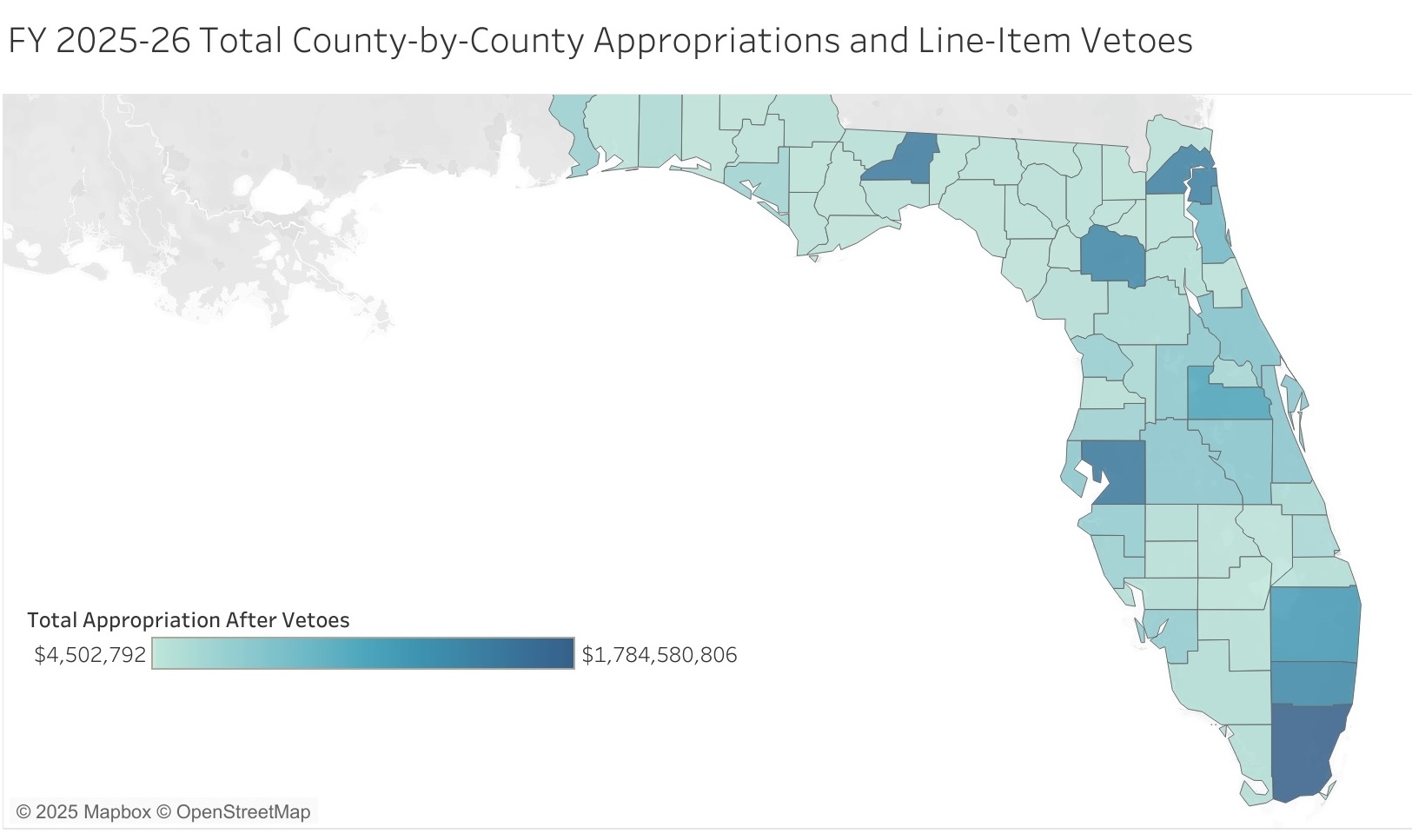
FY 2025-26 Budget Vetoes by County: an Interactive Map
To assist the public and add transparency concerning the FY 2025-26 vetoes, Florida Policy Institute has developed a tool to show vetoes as they impact counties.
Florida FY 2025-26 Budget: Introduction and Revenue Overview
Florida relies heavily on its general sales tax to balance its budget.
Cuts to Energy and Storm Readiness Funding in US House and Senate Reconciliation Proposals Would Mean Higher Utilities and Insurance Costs for Floridians
If the reconciliation package moves forward, tens of billions in federal investments and tax credits would be eliminated.
Behind the Numbers: What Floridians Should Know About the FY 2025-26 Tax Package
Once again, policymakers are pursuing tax cuts and plan to pay for them with budget cuts.
Statement on House Passage of Reconciliation Bill
Passage of this bill is an act of cruel disregard for the lives of millions of Americans.
Testimony on Heat Injury and Illness Prevention Before OSHA
FPI reiterates the need for uniform heat-illness protections.
77 Groups Sign Letter Urging Florida's US Senate Delegation to Reject Cuts to SNAP and Health Care
Proposed cuts would have devastating impacts on Florida families.
US House Reconciliation Bill Would Strip Away Access to Health Care Coverage and Food Assistance for Many Florida Immigrants
The House’s proposal would hit Miami-Dade County especially hard.
Register Now! The True Cost of Cuts: How the US House Reconciliation Bill Would Cause Widespread Hardship in Florida (Webinar)
Hear from FPI and Institute on Taxation and Economic Policy on the alarming cost of cuts happening to health care, safety net programs, and education in Florida.
Federal Voucher System — Like Florida’s — Would Divert Funding to Private Schools and Home-Schoolers
Florida has lessons to offer about vouchers.
4 Things That Floridians Should Know About the US House Reconciliation Bill
The bill would make deep cuts to critical health care and food assistance programs.
Statement on Governor DeSantis Signing SB 472, Expanding Economic Opportunity for Formerly Incarcerated Floridians
FPI is so proud to see one of our long-standing priorities become law.
Statement on US House Passage of Reconciliation Legislation
No child or adult in Florida should have to go hungry, nor should they be forced to forgo health care.
More than $1.6 Billion in SNAP Cuts to Florida Would Put Residents and State Budget at Risk in 2028
Florida could lose at least $1.6 billion in federal dollars for SNAP in 2028 under the U.S. House’s budget proposal.
Millions of Floridians With Marketplace Insurance and Those Who Receive Insurance Through Medicaid at Risk for Health Care Coverage Loss Under Advancing House Budget
The U.S. House's bill would let the enhanced Marketplace premium tax credit expire after 2025.
Statement on Ways and Means Committee Passing Proposal to Create a Federal K-12 Voucher Program
What has happened in Florida should be used as a cautionary tale.
Florida Budget Proposals in Brief (FY 2025-26): Education
The proposed total funding for K-12 education is $30.9 billion in the House bill and $31.7 billion in the Senate.
Statement on Extended Legislative Session and Child Labor Protections
The Florida Senate took an important step in protecting children by rejecting HB 1225 and SB 918.
Florida Budget Proposals in Brief (FY 2025-26): Tax and Revenue
Without a plan to raise revenue, significant tax cuts will offer little relief and prevent lawmakers from tackling ongoing budget challenges.
Florida Needs to Balance the Scales If It Wants to Cut Taxes
Floridians can’t afford short-term relief at the expense of long-term resilience.
Budget Reconciliation Efforts to Cut Food Assistance Threaten Floridians — and the State Budget
Cutting SNAP would be devastating to Floridians already struggling to make ends meet.
With a Few Tweaks, Florida’s ‘Housing’ Bill Would Address Affordability for the Most Cost-Burdened Residents
The legislation's massive reduction in unit requirements and the return to the qualified contract loophole is very concerning.
Florida Budget Proposals in Brief (FY 2025-26): Health and Human Services
Both chambers’ general revenue appropriations for Medicaid are nearly identical.
Florida Budget Proposals in Brief (FY 2025-26)
FPI highlights some of the key components of the House and Senate budget proposals.
Hope Florida Should Do a Deeper Dive Into a Family’s Long-Term Well-Being After They Leave Critical Basic Needs Programs
Without more transparency from Hope Florida, it is impossible to gauge its efficiency and long-term impact on Florida families and the state’s budget.
Florida Budget Proposals in Brief (FY 2025-26): Housing
As Florida passed its encampment ban last year, the creation of affordable units is paramount.
Florida at the Precipice: Proposed Congressional Cuts to Medicaid and SNAP and Impacts on Florida
Webinar on Proposed Congressional cuts to Medicaid and SNAP

Florida Budget Proposals in Brief (FY 2025-26): Safety Net
Neither the House nor the Senate propose to increase TANF payment levels.
Fast Facts: HB 1225 and SB 918 Would Further Erode Child Labor Protections in Florida
The legislation would impact over 110,000 Florida youth.
Florida Budget Proposals in Brief (FY 2025-26): Immigration Enforcement
For FY 2025-26, both chambers propose $680,046 and five new positions.
Florida Budget Proposals in Brief (FY 2025-26): Environment
Both the House and Senate FY 2025-26 proposals elevate funding for Florida Forever.
Florida Budget Proposals in Brief (FY 2025-26): Criminal Justice and Corrections
Both chambers’ budget proposals provide an overall increase for the Department of Corrections.
Testimony on HB 1225 Before the Florida House Education & Employment Committee
HB 1225 would further erode Florida's child labor law.
Florida Leadership Mum on Devastating Proposed Federal Cuts as State Lawmakers Negotiate Budget
Florida groups caution that impact of proposed federal cuts would reverberate in every county.
Florida Lawmakers Should Preserve Funding for Students in Advanced Academics and Career and Technical Education Classes
Florida’s students and schools will all be negatively affected by reductions in funding for advanced academic and technical preparation programming.
Florida Legislature Proposes Alarming Rollbacks of Child Labor Protections in 2025 Session
This 2025 session, the Legislature seeks to further chip away at the protections put in place for working teens in 2024.
Prison reform should be at the top of DeSantis’ DOGE agenda
DOC should be the first stop in the governor’s quest to ensure accountability and save taxpayer dollars.
Legislation Would Remove Long-Standing Occupational Licensing Barriers for Returning Citizens
People with past convictions are largely excluded from occupational licensing opportunities.
Floridians in Every County Rely on Safety Net Programs That Are at Risk in Federal Budget Negotiations
Millions rely on Medicaid, Supplemental Nutrition Assistance Program (SNAP) benefits, and other essential services.
Statement on House Committee's Passage of HB 1225
This could be the second year in a row that Florida lawmakers opt for rollbacks to the state’s child labor laws.
Testimony on HB 1225 Before the Florida House Industries and Professional Activities Subcommittee
HB 1225 would further erode child labor protections in Florida.
More Than 110,000 Florida Youth Could Be Impacted by Proposed Rollback of Child Labor Law Protections
The Florida Legislature could, for the second year in a row, erode protections for kids
Testimony on SB 918 Before the Florida Senate Commerce and Tourism Committee
The legislation would roll back child labor protections.
Nearly 7 in 10 Florida Voters Would Choose Property Taxes Over a 12% State Sales Tax Rate, Poll Shows
Replacing property taxes with a doubled state sales tax rate is unpopular among voters across the political spectrum.
Central Florida Town Hall Focused on Crucial Role SNAP and Medicaid Play in Helping Floridians
Florida groups and community members convened to talk about how massive proposed federal cuts to Medicaid and SNAP would impact families.
Town Hall: How Proposed Cuts to Medicaid and SNAP Could Impact Floridians
Town Hall on March 19
Floridians need a property tax break, but here’s why DeSantis’ proposal is dangerous | Opinion
There is no doubt that Floridians are struggling to afford living in the state, especially in South Florida.
Food Assistance at Risk for Over 2.9 Million Floridians As Congress Considers Deep Cuts to SNAP
Florida children, older Adults, people with disabilities, and rural Floridians are among those who could lose food assistance.
2025 Policy Agenda
FPI supports measures that help make the state a place where families can build a healthy future.
62 Groups Urge State Education Department to Protect Students and Teachers Following Alarming Immigration Enforcement Directive
Several of the signatories also participated in a press conference.


