


Executive Summary
For all except a wealthy few, the days when one income supported an entire family in the United States ended long ago. As the COVID-19 pandemic brought to light, parents are often working full-time to put food on the table and pay for their children's increasingly unaffordable daycare. When a major life change disrupts that work — be it a global pandemic or the welcoming of a new baby into a couple’s home — parents need to know that their jobs and pay will not be endangered as a result.
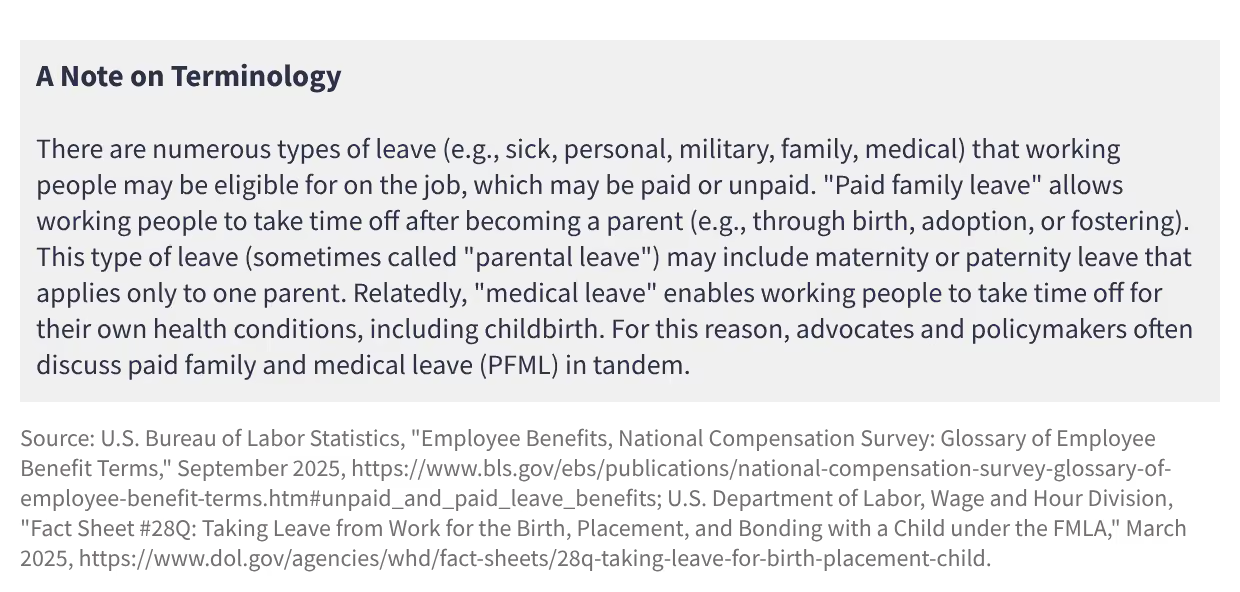
Over the past two decades, 13 states and the District of Columbia have passed their own paid family and/or medical leave (PFML) programs. Each policy varies greatly; however, almost all states provide at least six weeks of paid leave for both new mothers and fathers, including those who fostered or adopted children. In the 2024 legislative session alone, more than half the states filed PFML bills.[1] Florida has not yet passed its own paid family leave policy.
With assistance from Vanderbilt University’s Prenatal-to-3 Policy Impact Center, Florida Policy Institute (FPI) estimated the potential costs and benefits of offering PFML to all working Floridians — in both the public (i.e., state, local) and private sectors.
FPI estimates that a statewide paid leave program would:
- Allow Floridians to receive between $560 and $1,358 of their regular pay for each week they took leave, depending on income
- Benefit between 194,000 and 366,000 Floridians, depending on leave length and type
- Be funded with payroll deductions totaling just $32 to $350 per year, depending on income
FPI also found that:
- More than triple the number of Black Floridians, double the number of non-Hispanic white Floridians, and 1.5 times the number of Hispanic Floridians would benefit from eight weeks of PFML compared to eight weeks of paid leave only.
- Offering 12 weeks of paid family leave instead of eight would only require a 0.1-percent premium increase for Floridians.
Florida Needs a Statewide, Comprehensive Paid Family Leave Policy
Since the 1990s, the United States has had a family leave policy — the Family and Medical Leave Act — that grants working people 12 weeks of leave without fear of losing their job under certain circumstances (e.g., childbirth, medical issues). Unfortunately, this leave is unpaid. The United States is one of only two countries without a paid family leave policy. [2]
Moreover, Florida does not currently have its own statewide paid family leave policy to cover working parents in the private or public sectors. Instead, the state has taken an incomplete approach to the issue, covering only some public workers and neglecting Floridians in the private sector altogether.[3] Until recently, state employees who needed time off after the birth of a child had to use sick, annual, or unpaid leave.
In 2023, Gov. Ron DeSantis addressed this with a paid family leave policy for certain salaried and full-time state workers.[4] While this policy was a positive addition, it remains inequitable and incomplete. It does not benefit all public workers, and it is biased toward women giving birth, granting less leave to fathers and to parents who adopt. Those who foster young children are entirely ineligible for leave.
Specifically, mothers are granted seven weeks of paid maternity leave after childbirth plus two weeks’ leave for care and bonding of a child after birth or adoption, totaling nine weeks. Fathers and adoptive parents are eligible only for care and bonding leave, totaling two weeks. Both parents can add seven weeks of their paid sick leave benefits to take more family leave; however, this leaves parents with less coverage for days they (or their children) are ill and they cannot report to work.
Moreover, Florida does not currently have its own statewide paid family leave policy to cover working parents in the private or public sectors. Instead, the state has taken an incomplete approach to the issue, covering only some public workers and neglecting Floridians in the private sector altogether.
In 2025, Florida House Speaker Daniel Perez announced a paid family leave plan for all full-time House members and staff that mirrored the governor’s policy for other state employees. Like the governor’s policy, the new House policy grants mothers seven weeks of paid leave after childbirth and an additional two weeks for care and bonding. Fathers and adoptive parents are only eligible for the two-week care and bonding benefit. However, the House’s policy is less generous than the governor’s policy. For example, House employees cannot take leave during the legislative session, and it only allows parents to use six (instead of seven) weeks of their sick leave benefits to extend their paid family leave time.[5]
Furthermore, a 2013 state law prevents local governments from passing any policies that mandate paid leave for Floridians in the private sector.[6] Without a comprehensive policy, an estimated 76 percent of working Floridians, or around 8.4 million, do not have access to paid family leave.[7]
Denying Working People Paid Family Leave is Costly and Harmful
In nearly 3 million households (72 percent of all Florida families), all parents work, and approximately 224,400 Florida children are born each year. Yet most working Floridians (76 percent) lack access to paid leave through their employers, totaling 8.5 million people.[8] Without this vital benefit, Florida’s economy is negatively impacted. Specifically, for every year that working Floridians are unable to take sufficient leave, they lose $2.8 billion in wages. Women in the state lose $1.5 billion (54 percent of all lost wages).[9] Florida parents lose wages when they either receive insufficient paid or unpaid leave or have to leave the workforce entirely.[10]
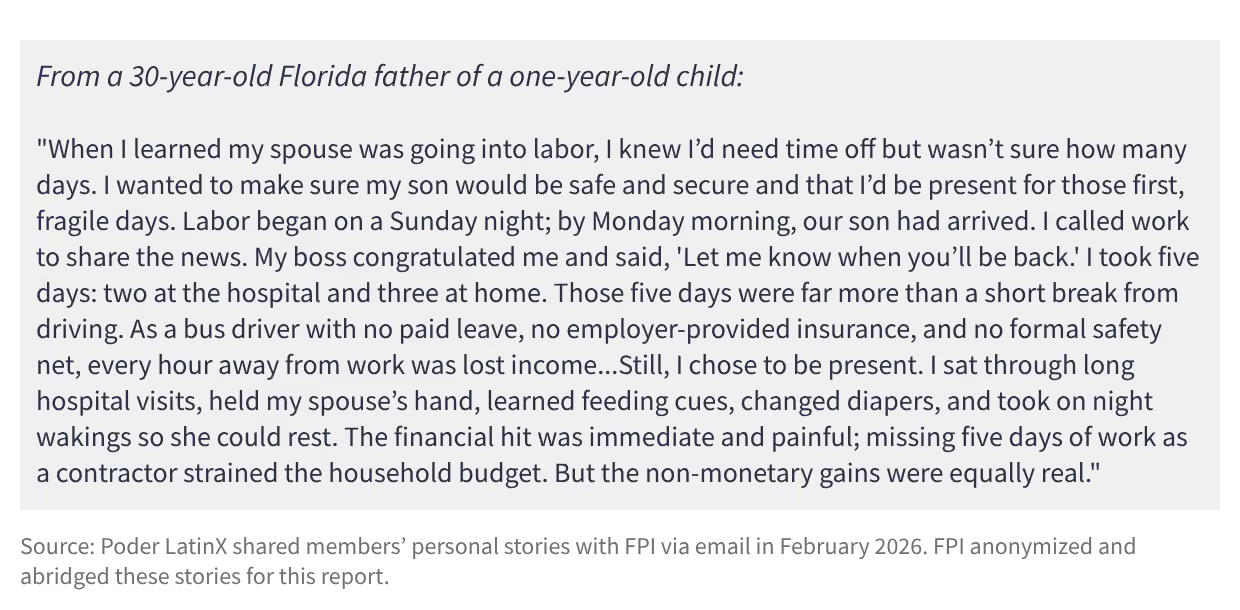
While it is important to offer paid family leave for both men and women, the latter tend to be default parents and absorb the bulk of child-rearing duties, whether they gave birth to or adopted their child. Women tend to remain the default parent even when working full- or part-time.[11] Increasingly, women of color are becoming family breadwinners, making any cuts in income even more devastating. Nationally, 64 percent of Native American mothers are breadwinners. In Florida, 77 percent of Black mothers, 52 percent of Latina mothers, and 49 percent of white mothers are breadwinners.[12]
Over time, this lack of paid family leave means that fewer parents — especially young women — remain in the workforce. If they do keep working, this lack of support limits their productivity and wages. A 2023 national survey found 35 percent of working people aged 18 to 29 left a job or were fired because they lacked PFML.[13] This lack of support harms working people themselves, their households, and businesses — and the larger public misses out on spending and tax revenue over time. Turnover is expensive and time-consuming, costing an average of 40 percent of a former employee’s pay to replace them.[14]
PFML is Good for Working People and Their Children
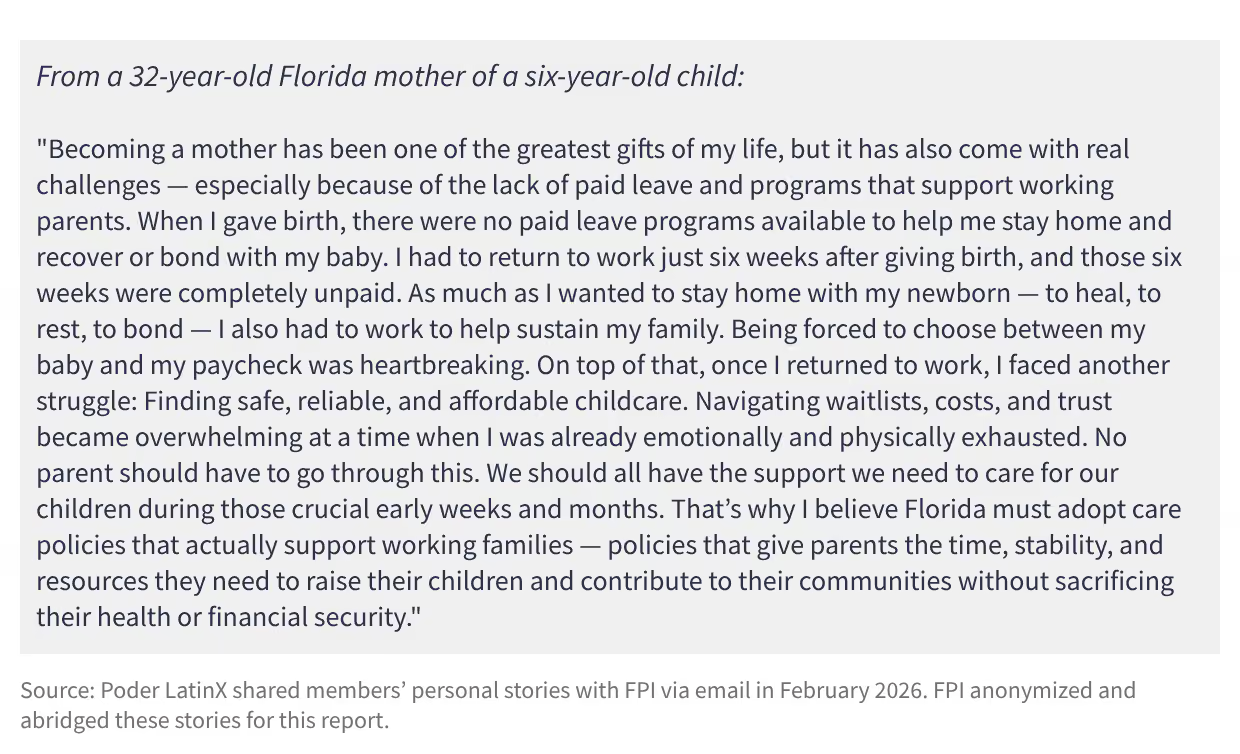
A review of best practices and the strongest research studies points clearly to the benefits of PFML for parents and their children.[15] Notably, studies show that access to statewide paid family leave reduces postpartum depression overall, but especially for Black women.[16] Relatedly, access to PFML mitigates alcohol consumption for both parents and reduces infant death before age one by 12 percent. PFML also grants mothers more quality time with their children, which aids in their development. Specifically, mothers with PFML are more than twice as likely to read to their children, and they take them on outings almost twice as many times per month.[17]
Meanwhile, fathers who take paid family leave take less sick time off work, are hospitalized less, and ultimately live longer than fathers who do not take paid family leave. Fathers with paid family leave are also more engaged in their children’s day-to-day lives, which improves their cognitive and developmental abilities.[18] Having a state with healthy, well-adjusted kids leads to healthier, happier families and working people over time.
Having PFML also helps keep families economically stable in the long run. Parents are more likely to stay at their jobs and put in more hours, thus financially struggling less than those without PFML. For example, mothers with PFML are 13 percent more likely to return to their employer after welcoming a new child. When they return to work, mothers with PFML work an average of seven weeks more in their child’s second year than those without PFML, and they put in more hours each week.[19] As a result, parents who have PFML — especially single mothers with less education or income — are less likely to live in poverty than parents who do not have it. Similarly, families with PFML are less likely to experience food insecurity if they have multiple children.[20]
PFML is Good for Business
Businesses increasingly support paid family leave policies. In a 2017 national poll, 70 percent of small businesses supported a government-wide PFML policy covering up to 12 weeks, split evenly between employees and employers. In that same poll in 2024, 79 percent of small businesses (nearly 8 in 10) supported PFML, reflecting growing interest in such policies.[21] After California passed its paid family leave policy, nearly 90 percent of its small businesses strongly supported the program.[22]
In the absence of such a policy, some states have passed laws that allow companies to offer paid family leave as part of their employer-offered insurance options; however, participation is voluntary. Florida passed such a law in 2023.[23] Yet, in a 2024 small business poll, U.S. employers were twice as likely to prefer a government-wide PFML program over a voluntary insurance opt-in.[24]
Companies also recognize that they are at a disadvantage without paid family leave policies. Human resource professionals say that family-friendly policies, such as paid leave, are the top factor in attracting and retaining workers.[25] Correspondingly, a 2023 poll of over 2,200 Americans found nearly 75 percent of working people want companies to provide PFML, and 61 percent of relocating workers were more likely to move to states that mandate PFML.[26]
Furthermore, research shows that companies with paid leave policies experience higher productivity and profits. For example, manufacturing and technology companies that offer paid leave saw a 5-percent increase in revenue and a 7-percent increase in profits per employee. These industries, respectively, reported average returns of $2.57 and $2.64 per dollar invested in staff.[27] Economists found that over 23 years, businesses in states with paid family leave laws saw significantly higher worker productivity than similar businesses did in states without these benefits.[28]
How Statewide Paid Leave Could Benefit Florida
With assistance from Vanderbilt University’s Prenatal-to-3 (PN-3) Policy Impact Center, FPI estimated the potential costs of extending PFML to all working Floridians — in both the private and public (i.e., state, local) sectors. (For details on the Department of Labor tool and assumptions that went into this model, see Methodology below.)
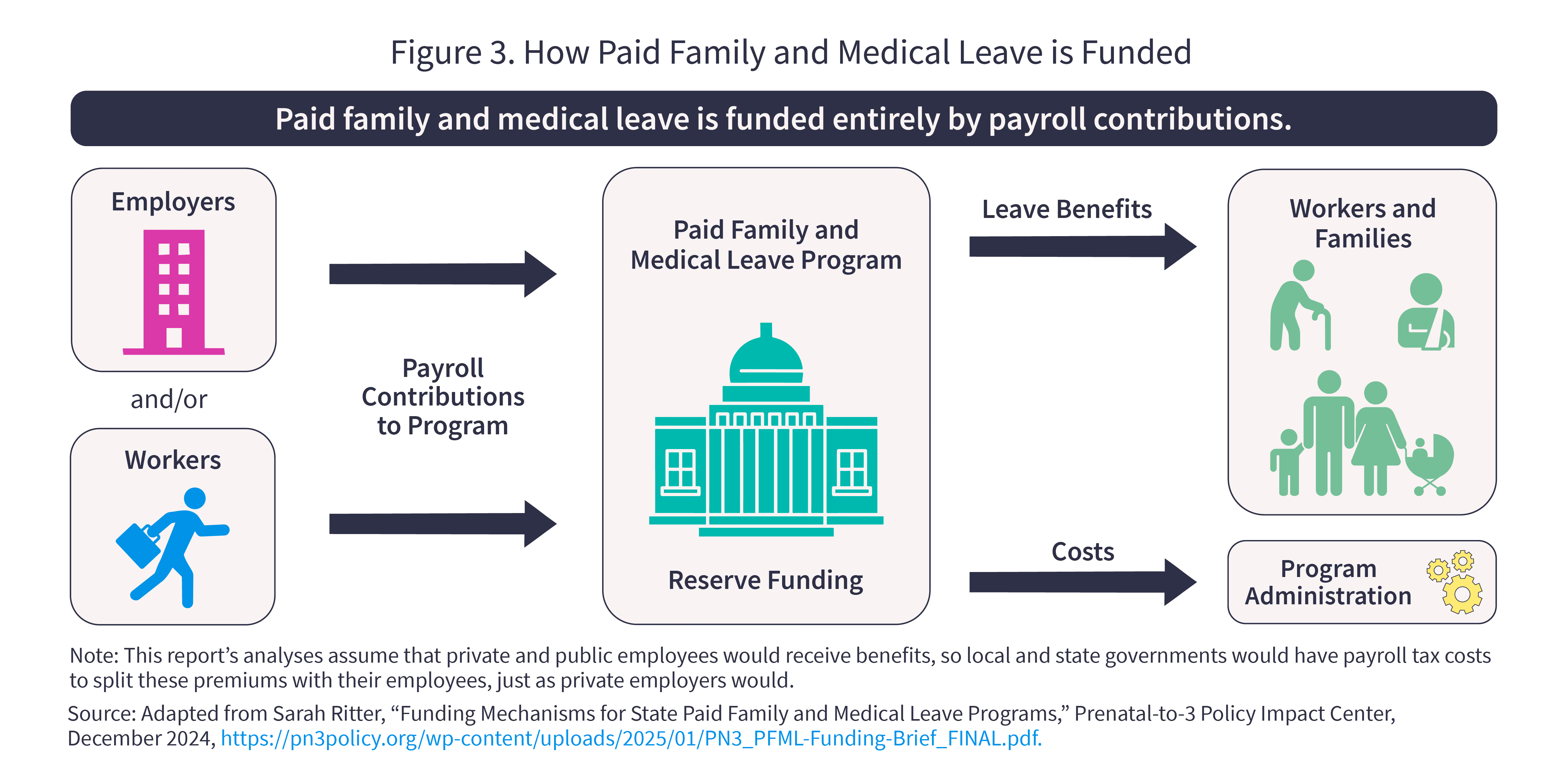
This report outlines four different scenarios (or program designs). All four scenarios replace 100 percent of Floridians’ wages[29] and would not require a recurring appropriation from the state’s general revenue fund. (See Figure 3.) The scenarios differ by the duration of leave each program design grants (eight or 12 weeks) and the types of paid leave each includes (family leave, medical leave, or both).
The most effective models in other states show that at least 12 weeks of paid leave after childbirth (and slightly less for fathers and parents who adopt or foster) reap the greatest benefits to workers.[30] With this in mind, FPI modeled the following four scenarios statewide:
- Paid family and medical leave for 12 weeks
- Paid family and medical leave for eight weeks
- Paid family leave only (excluding separate medical leave benefits) for 12 weeks
- Paid family leave only (excluding separate medical leave benefits) for eight weeks
To ensure equity in any future paid leave policy in Florida, FPI’s modeling does not differentiate between maternity and paternity leave, nor between children born, adopted, or fostered.
Floridians Would Receive Between $560 and $1,358 in Leave Benefits Per Week
All four scenarios assume a marginal wage replacement rate of 100/50 percent, meaning the amount replaced would be 100 percent of workers’ pay up to a certain amount, then 50 percent of the rest. This report’s findings assume that when an employee is on leave, paid family leave or PFML would replace 100 percent of all their wages that fall below half of Florida’s 2026 State Average Weekly Wage (SAWW) of $1,358, then 50 percent of any additional pay, up to the maximum weekly benefit of $1,358. The maximum weekly benefit is determined by Florida’s statewide average weekly wage (SAWW), which stands at $1,358.[31]
Table 1 highlights the weekly and total PFML benefit amounts for different income categories, including a full-time worker paid Florida’s current minimum wage, the SAWW, and the cut-off pay for receiving the maximum weekly benefit (i.e., the maximum replaceable wage). Depending on the length of PFML benefits adopted in Florida, each Floridian who took PFML could expect between $4,500 and $16,300 of their pay to be replaced while they are out.
Figure 1 displays each worker’s estimated weekly benefits and earnings. In practice, this shows that as Floridians earn more, PFML replaces a smaller share of their pay. Thus, PFML is particularly beneficial for Floridians paid lower wages (e.g., $14 per hour).
194,000 to 366,000 Floridians Would Benefit from Statewide Paid Leave
The U.S. Department of Labor’s (DOL’s) Worker PLUS tool allowed FPI to estimate the number of Floridians who would benefit if the state were to implement one of the four paid family leave programs modeled for this report. These estimates are based on validated analyses by the DOL’s Women’s Bureau, incorporating the number of working people who can access paid leave and family medical leave (FMLA) programs in other states, along with other factors. See Methodology for more information.
Table 2 displays the number of Floridians that FPI expects would benefit from a statewide paid leave program, ranging from eight weeks of paid family leave to 12 weeks of PFML. In the least generous scenario of eight weeks of paid family leave only, FPI estimates nearly 194,000 Floridians would use these benefits. Increasing paid family leave to 12 weeks for all Floridians only marginally expands the number of estimated Floridians who would benefit. Thus, it would be common-sense policy to opt for a longer-term program, given the minimal difference in take-up rates and, subsequently, the program's costs (see Figure 4). If the state offered PFML for 12 weeks, even more Floridians would benefit — an estimated 366,353 people.
Figures 2a and 2b estimate the number of Floridians by race and age who would benefit from a statewide PFML program, using the DOL Worker PLUS tool. This tool includes U.S. Census demographic data from the American Community Survey.
Figure 2a shows that, overall, while thousands of Floridians of all races would benefit from a statewide paid leave program, white and Hispanic[32] Floridians would benefit in greater numbers, followed by Black Floridians. This disparity is to be expected, as more white and Hispanic Floridians are in the labor force than other races.[33] Throughout the U.S., especially since the COVID-19 pandemic, Black Americans have faced disproportionately higher levels of unemployment than their Asian, Hispanic, and white peers. Higher unemployment for Black Americans is a direct effect of discriminatory policies, including the reversal of diversity, equity, and inclusion initiatives.[34] In Florida, for example, 8.5 percent of Black working-age Floridians (16 and older) were unemployed in 2020 (the same Census data year for the demographic analyses in Figures 2a and 2b). In contrast, only 4.7 and 5 percent of their white and Hispanic peers were.[35]
Increasing paid family leave to 12 weeks for all Floridians only marginally expands the number of estimated Floridians who would benefit. Thus, it would be common-sense policy to opt for a longer-term program, given the minimal difference in take-up rates and, subsequently, the program's costs. If the state offered PFML for 12 weeks, even more Floridians would benefit — an estimated 366,353 people.
However, when comparing estimated leave-takers between paid family leave only and paid family and medical leave (PFML) programs, Figure 2a shows Black Floridians stand to benefit in greater numbers. At eight weeks of paid leave, an estimated 21,915 Black Floridians would benefit, whereas at eight weeks of PFML, an estimated 68,399 would — more than triple that number. Conversely, for non-Hispanic white and Hispanic Floridians, leave-taking from eight weeks paid family leave to eight weeks PFML increases by 2 and 1.5 times, respectively.
Moreover, studies of PFML in other states show that when offered the benefit, non-Hispanic Black and Hispanic mothers increased their leave-taking by 14.4 and 6.4 percentage points, respectively; white mothers did so by just 3.2 percentage points.[36] This difference in leave-taking is because inequitable policies and hiring practices have historically relegated these minority groups to lower-wage work than their white peers. Thus, when unpaid leave is the only option their employer offers, non-Hispanic Black and Hispanic mothers are less likely to take advantage of it, as they may be less able to afford it than other workers. [37]
Figure 2b shows that adults of all ages would benefit from a statewide PFML program, including between 85,700 and 130,400 Floridians aged 25 to 34, depending on the program scenario. Labor experts consider the prime working age to be 25 to 54, and this group's labor force participation is at its highest level in decades.[38] Thus, knowing this vital group of working people would benefit most from a paid leave program is an important consideration.
Increasingly, however, many Americans are having or adopting children later in life (beyond the age of 35).[39] As such, paid leave remains important to them as well. Figure 2b shows that a significant number of Floridians aged 35 to 44, a range of 56,200 to 99,300 people, would also benefit from statewide paid leave.
Small Premiums Can Fund Statewide Paid Leave
In all states with statewide PFML programs, the state does not provide a recurring appropriation from its general revenue fund. Instead, workers and employers pay premiums to finance these programs, generating revenue through paycheck deductions. Premiums cover the cost of benefits and program administration, plus any required reserve funds. See Figure 3 for an overview of how PFML programs are typically funded.
As Figure 4 shows, between providing leave benefits and small costs required to administer each program, FPI estimates a statewide paid leave program would cost between $913 million for the least generous scenario (eight weeks of paid family leave) and $2.46 billion for the most generous scenario (12 weeks of PFML).
When estimating the premiums required to cover these programs, three factors are important to consider: how employers and employees split premiums, the maximum amount of workers’ pay subject to the premium (known as the contribution wage base), and the premium’s share of workers' pay. All four program scenarios in this report assume that employees pay 55 percent of premiums and employers pay the remaining 45 percent, which is common in other states with PFML. This report’s findings assume the contribution wage base is the same as that used for Social Security benefits ($184,500 in 2026).[40]
Figure 4 and Table 3 demonstrate premium contributions and overall program costs based on premium shares of 0.2 and 0.6 percent of working Floridians’ annual pay. As Figure 4 shows, premiums ranging from 0.2 to 0.6 percent of workers’ annual pay would generate between $995 million and $2.52 billion, more than enough to cover these programs’ costs.
Table 3 shows that the most generous program modeled, 12 weeks of PFML for all Floridians, could be funded with just a 0.6-percent premium share (i.e., 0.33 percent deducted from employees’ paychecks, with the remaining cost covered by the employer). Depending on Floridians’ pay, this share would require annual premiums ranging between $175 ($96 from the employee) and $636 ($350 from the employee). The least generous program, eight weeks of paid family leave, would require only a 0.2-percent premium share. A 0.2-percent share equates to annual payroll deductions ranging from $58 ($32 from the employee) to $212 ($117 from the employee).
Florida Must Move Beyond Patchwork Policy Approaches to Paid Family Leave
Summary of Recent Paid Family Leave Bills
In the 2025 legislative session, the Florida Senate filed Senate Bill (SB) 76 to slightly improve the 2023 state employees’ policy in three major ways. First, it would have required paid “parental leave” (i.e., paid family leave) of 12 weeks for both the mother and father, whether for childbirth or adoption. Second, it stipulated that the state could not refuse to grant family leave for any reason. Third, it would have prohibited the state from requiring employees to use annual or sick leave before they could access their 12 weeks of paid family leave.[41] SB 76 did not pass or receive a hearing in a legislative committee, nor did its 2026 refiles, SB 220[42] and HB 825.[43]
Even if SB 220/HB 825 had passed, however, there would still be countless working Floridians left out of a comprehensive paid leave program, as only select state workers would have been eligible under this proposal. Private employees, county or local workers, and temporary or contract employees would not have been eligible. Furthermore, foster parents are not currently eligible for the state's limited paid leave programs, nor would they have been under SB 220/HB 825. Infants are often placed in foster homes — often with little notice — which can disrupt a parent’s ability to work as usual.
Recommendations
Although Florida’s incremental policies for select public workers are a good start, they do not go far enough. The sensible approach would be for Florida to pass a comprehensive paid family leave policy in the next legislative session. Building on effective models in other states,[44] such a policy should include, at a minimum:
- 12 weeks of paid family leave for mothers recovering from childbirth
- 8 weeks of paid family leave for all other workers (i.e., foster and adoptive parents, fathers)
However, ideally, Florida would offer much more than eight weeks to parents who do not give birth, including fathers. While medical recovery is not a concern for those who do not give birth, it is still inequitable to deny Floridians who either cannot or choose not to have biological children significantly more time to bond with their children or support their partners at home.
Until the state offers a comprehensive, paid family leave plan for all Floridians, state leaders could consider incremental changes. These changes include:
- Repealing the 2013 law that blocks local governments from mandating employment benefits (including paid leave) for private workers and government subcontractors
- A task force for providing recommendations to the state
- A pilot program with a rigorous evaluation built in, since most of the research on these policies is from a handful of states[45]
Methodology
Determining Floridians to benefit from statewide paid family (and medical) leave
This report estimates the number of Floridians who would take up paid leave with the U.S. Department of Labor (DOL)’s Worker Paid Leave Usage Simulation (Worker PLUS) model. Take-up rates for Florida are based on validated analyses by the DOL's Women’s Bureau, which incorporate the number of working people who access paid leave and family medical leave (FMLA) programs in other states, along with a handful of related factors. Specifically, all four program designs in this report assume take-up rates for income-eligible adults of 2.25 percent (own medical health), 0.48 percent (maternity), 2.25 percent (care and bonding), and 0.2 percent each for an ill child, spouse, and parent who is caregiving.
The estimates include private, public (excluding federal), and self-employed workers who opt in to the four programs modeled. The DOL Worker PLUS model can only determine whether self-employed workers are eligible or ineligible for these programs, not the share who opt in. In practice, rates of self-employment opt-ins for PFML programs range from 0.06 to 7.4 percent of self-employed workers, according to a 2023 report from the Center for American Progress. This model assumes that all self-employed workers in the state would opt in to the program (a 100 percent take-up rate), so this report may slightly inflate the leave-taking population.
The model also cannot directly account for those who already receive paid family and/or medical leave under the state’s recent policy changes. Although the Worker PLUS model can technically simulate a state-employee program, it requires making assumptions about take-up rates that would compromise the validity of the resulting data.
Premium calculations
Premium rates may fluctuate annually to maintain each program's solvency, with a cap on the maximum premium rate. This report modeled a variety of premiums to determine the rates needed to fund each of the four program scenarios. These estimates were determined separately from cost-benefit analyses to prevent the Worker PLUS model from using restrictions on benefit eligibility to limit the pool of workers paying premiums.
Cost estimate considerations
Since the Worker PLUS tool was modeled on the first few states that adopted PFML, each type of leave has its own maximum length, and there is no way to set a cumulative limit across all types when running the model. As such, in all designs, some simulated leave takers may exceed the maximum leave length intended for the design (i.e., eight or 12 weeks). Vanderbilt University’s Prenatal-to-3 Policy Impact Center developed an exploratory method for enforcing cumulative limits on leave duration by directly interfacing with the Worker PLUS model’s simulation dataset. Based on this analysis, this report may inflate the benefit costs by up to 15 percent. Thus, these cost estimates are likely on the higher end of what is plausible.
For more detailed technical notes, see the U.S. Department of Labor’s Worker Paid Leave Usage Simulation Model user manual (dated January 5, 2021).
Notes
[1] Vanderbilt University, Peabody College of Education & Human Development, Prenatal-to-3 Policy Impact Center, ”State Policy Roadmap 2024: Paid Family and Medical Leave,” n.d., https://pn3policy.org/pn-3-state-policy-roadmap-2024/us/paid-family-medical-leave/.
[2] A Better Balance, “The Health Case for Paid Family and Medical Leave,” updated April 2, 2025, https://www.abetterbalance.org/resources/the-health-case-for-paid-family-and-medical-leave/.
[3] While Florida did pass a 2023 paid leave bill that included private companies, it is not a guaranteed benefit as a statewide paid leave program would be. Rather, it grants companies the option to offer paid leave insurance as part of their existing disability offerings. See Laws of Florida, Ch. 2023-149, https://laws.flrules.org/2023/149.
[4] Executive Office of the Governor, “Governor Ron DeSantis Expands Maternity and Family Leave for State Employees,” September 18, 2023, https://www.flgov.com/eog/news/press/2023/governor-ron-desantis-expands-maternity-and-family-leave-state-employees. Eligible state workers include Career Service, Selected Exempt Service, or Senior Management Service employees with one year of cumulative service in the last seven years within the State Personnel System of Florida. See Department of Management Services—State of Florida, “Paid Parental Leave,” updated 2026, https://www.mybenefits.myflorida.com/work_and_life/additional_benefits/paid_leave_of_absence/paid_parental_leave.
[5] Gabrielle Russon, “House Expands Paid Parental Leave for Employees, Daniel Perez Says,” Florida Politics, December 8, 2025, https://floridapolitics.com/archives/768779-house-expands-paid-parental-leave-for-employees-daniel-perez-says/.
[6] Alexis P. Tsoukalas and Adriana Sela, “The Florida Timeline, 2013 – The Legislature Sidelines Local Workers from Employment Benefits,” October 2023, Florida Policy Institute, https://www.floridatimeline.org/timeline/2013-the-legislature-sidelines-local-workers-from-employment-benefits/.
[7] National Partnership for Women and Families, ”Paid Leave Means a Stronger Florida,” February 2026, https://nationalpartnership.org/wp-content/uploads/2023/04/paid-leave-means-a-stronger-florida.pdf.
[8] National Partnership for Women and Families, “Paid Leave Means a Stronger Florida,” February, 2026, https://nationalpartnership.org/wp-content/uploads/2023/04/paid-leave-means-a-stronger-florida.pdf.
[9] National Partnership for Women and Families, “Paid Leave Means a Stronger Florida,” February, 2026, https://nationalpartnership.org/wp-content/uploads/2023/04/paid-leave-means-a-stronger-florida.pdf.
[10] National Partnership for Women and Families, February 2026.
[11] Sarah Damaske, For the Family? How Class and Gender Shape Women’s Work, Oxford University Press, 2011.
[12] National Partnership for Women and Families, February 2026.
[13] Sapna Mehta, Nia West-Bey, and Kirby Phares, “Voters Favor Policy Investments to Support Young Adults, Including Employment Training and Paid Family and Medical Leave,” Data for Progress and The Center for Law and Social Policy, March 2024, https://www.filesforprogress.org/memos/clasp-dfp-young-adult-training-employment.pdf.
[14] Kate Bahn and Carmen Sanchez Cumming, “Improving U.S. Labor Standards and the Quality of Jobs to Reduce the Costs of Employee Turnover to U.S. Companies,” Washington Center for Equitable Growth, December 2020, https://equitablegrowth.org/wp-content/uploads/2020/12/122120-turnover-costs-ib.pdf.
[15] Vanderbilt University, Peabody College of Education & Human Development, Prenatal-to-3 Policy Impact Center, ”Summary of the Rigorous Research on Paid Family and Medical Leave,” October 2024, https://pn3policy.org/wp-content/uploads/2024/10/PN3PIC_PaidFamilyMedicalLeave_Snapshot_1024.pdf.
[16] Whitney M. Wells, et al., “Effects of US State Paid Family Leave Policies On Perinatal And Postpartum Health: A Quasi-Experimental Analysis,” American Journal of Epidemiology, Vol. 195, No. 1, February 2025, https://doi.org/10.1093/aje/kwaf010.
[17] Prenatal-to-3 Policy Impact Center, October 2024.
[18] A Better Balance, April 2, 2025.
[19] Vanderbilt University, Peabody College of Education & Human Development, Prenatal-to-3 Policy Impact Center, “Evidence Review: Paid Family and Medical Leave,” September 2025, https://pn3policy.org/wp-content/uploads/2025/09/PN3PIC_PaidFamilyMedicalLeave_EvidenceReview_0925.pdf.
[20] Prenatal-to-3 Policy Impact Center, October 2024.
[21] Small Business Majority and National Partnership for Women and Families, “Issue Brief: Small Businesses Support a National Paid Family Medical Leave Program,” October 2024, https://nationalpartnership.org/report/small-businesses-support-national-paid-family-medical-leave-program/.
[22] Small Business Majority, “California Small Businesses Support Expanding State Paid Sick Days and Family Leave Policies,” July 12, 2023, https://smallbusinessmajority.org/press-release/california-small-businesses-support-expanding-state-paid-sick-days-and-family-leave-policies.
[23] Laws of Florida, Ch. 2023-149, https://laws.flrules.org/2023/149.
[24] Small Business Majority and National Partnership for Women and Families, October 2024.
[25] Adrienne Davis, et al., “Unbending Gender: Why Family and Work Conflict and What to Do About It (Panel Two: Who's Minding the Baby?),” American University Law Review, Vol. 49, No. 901, August 2000, https://scholarship.law.ufl.edu/facultypub/99/.
[26] Business for Social Responsibility (BSR), “Poll: State Policies on Issues Such as Gun Violence, Abortion Access, Climate Change are Key Considerations for US Workers, Companies,” April 10, 2023, https://www.bsr.org/en/news/poll-state-policies-on-gun-violence-abortion-access-climate-change-are-key-considerations-for-u.s-workers-companies.
[27] Panorama and American Sustainable Business Council, “The Business Impacts of Paid Leave: A Financial Analysis of the Return on Investment of Paid Family and Medical Leave,” October 2019, https://assets-global.website-files.com/62448c65f2a3dc7ae94193bd/62448c65f2a3dc0f7a4195a2_Business-impacts-of-paid-leave-A-Panorama-report.pdf.
[28] Benjamin Bennett, et al., “Paid Leave Pays Off: The Effects of Paid Family Leave on Firm Performance,” December 10, 2025, https://academic.oup.com/rof/advance-article-abstract/doi/10.1093/rof/rfaf072/8376348.
[29] All four scenarios assume a marginal wage replacement rate of 100 percent, meaning the amount replaced would be 100 percent of workers’ pay up to a certain amount. In this model, that means 100 percent of all wages that fall below 50 percent of the 2026 State Average Weekly Wage (SAWW), then 50 percent of any additional wages up to the maximum weekly benefit. The maximum weekly benefit for all scenarios is equal to the 2026 SAWW, $1,357.95. In concrete terms, then, this report assumes Floridians granted leave would receive benefits that equal 100 percent of their weekly pay falling under $678.98 (half of the SAWW), then 50 percent of their pay above $678.98, up to a maximum weekly benefit of $1,357.95. So, if a working Floridian earns more than $1,357.95 per week, they would still only be paid $1,357.95 for each week they are granted paid leave.
[30] Vanderbilt University, Peabody College of Education & Human Development, Prenatal-to-3 Policy Impact Center, “Paid Family and Medical Leave, Evidence Review Findings: Effective/Roadmap Policy,” September 2025, https://pn3policy.org/wp-content/uploads/2025/09/PN3PIC_PaidFamilyMedicalLeave_EvidenceReview_0925.pdf.
[31] Florida Department of Financial Services, Division of Workers’ Compensation, “Information Bulletin: Maximum Workers Compensation Rate, Effective January 1, 2026,” December 2, 2025, https://myfloridacfo.com/docs-sf/workers-compensation-libraries/workers-comp-documents/bulletins/max-comp-rate-2026---information-bulletin.pdf.
[32] FPI only uses the term "Hispanic" when citing data or quoting a source.
[33] U.S. Census Bureau, American Community Survey, 2020 5-Year Estimates, Table S2301, https://data.census.gov/table/ACSST5Y2020.S2301?q=labor+force+participation+by+race+in+Florida&t=Employment+and+Labor+Force+Status&moe=false. The DOL Worker PLUS tool uses 2020 ACS data to determine estimated leave-takers by race and age, so the same data year is cited here for more apt comparison between leave-takers to benefit and current employment status.
[34] See Table 1 in Kyle K. Moore, “State Unemployment by Race and Ethnicity,” Economic Policy Institute, updated December 2025, https://www.epi.org/indicators/state-unemployment-by-race-and-ethnicity/.
[35] U.S. Census Bureau, 2020 ACS 5-Year Estimates, Table S2301.
[36] Prenatal-to-3 Policy Impact Center, September 2025, p. 11.
[37] Irene Brown (Ed.), Latinas and African American Women at Work: Race, Gender, and Economic Inequality, Russell Sage Foundation, 1999, pp. 1-18.
[38] Henry Epp, “Why Labor Force Participation Has Stayed About the Same for Years, Apart from the Pandemic,” Marketplace, October 7, 2024, https://www.marketplace.org/story/2024/10/07/steady-labor-force-participation.
[39] Brian Tsai, “The Rising Age of Motherhood in the United States,” Centers for Disease Control and Prevention, NCHS: A Blog of the National Center for Health Statistics, June 13, 2025, https://blogs.cdc.gov/nchs/2025/06/13/7780/.
[40] U.S. Social Security Administration, “Contribution and Benefits Base,” https://www.ssa.gov/oact/cola/cbb.html.
[41] Florida Senate Bill 76 (2025) “Paid Parental Leave,” https://www.flsenate.gov/Session/Bill/2025/76.
[42] Florida Senate Bill 220 (2026) “Paid Parental Leave,” https://www.flhouse.gov/Sections/Bills/billsdetail.aspx?BillId=82738&SessionId=113.
[43] Florida House Bill 825 (2026) “Paid Parental Leave,” https://www.flhouse.gov/Sections/Bills/billsdetail.aspx?BillId=82738&SessionId=113.
[44] Prenatal-to-3 Policy Impact Center, September 2025.
[45] Prenatal-to-3 Policy Impact Center, September 2025.